
On Thursday, oil and gas facilities throughout the Persian Gulf were targeted following an Israeli airstrike on the South Pars natural gas field, a crucial energy resource for Iran. This incident signifies a notable intensification of the ongoing conflict affecting much of the Middle East.
In the wake of the South Pars attack, U.S. President Donald Trump stated that Israel would refrain from further assaults on the gas field. However, he cautioned that should Iran persist in its attacks on Qatar’s energy infrastructure, the United States would respond by “massively blowing up the entirety” of the field.
Attacks on oil and gas installations in the vicinity, coupled with the closure of the Strait of Hormuz, have severely constrained global supply and transportation routes, leading to a sharp rise in energy prices.
-
Global markets sink, fuel prices soar as Iran hits Gulf refineries in multiple countries
-
Tehran intensifies attacks on Gulf energy facilities after Israel hits Iranian gas field
Following the news of the South Pars strike, global oil prices surged, along with an increase in gas prices across Europe, as concerns about potential Iranian retaliation against Gulf energy assets mounted.
Here is what we currently know about the affected sites in the Middle East and the expected energy disruptions they will bring.
South Pars natural gas field: Iran
Iran has escalated its offensive against Gulf energy installations after Israel targeted South Pars on Wednesday. The full extent of the damage caused remains uncertain.
Shared by Iran and Qatar—a close ally of the U.S.—South Pars is recognized as the largest natural gas field globally.
The Iranian side is referred to as South Pars, while it is known as the North Field on the Qatari side.
Targeting this gas field is crucial as it serves as Iran’s primary energy source in a nation often challenged by electricity production. Approximately 80% of Iran’s natural gas supply is sourced from South Pars.
Despite having a smaller economy, Iran ranks as the fourth-largest natural gas consumer worldwide, following the U.S., China, and Russia, according to the Center on Global Energy Policy at Columbia University.
Previously, Israel had targeted fuel depots within mainland Iran, while the U.S. had struck military installations at Kharg Island, Iran’s primary oil export terminal.
Ras Laffan facility: Qatar
Despite having a relatively small population, Qatar has invested billions into the development of its North Field as a key source of liquefied natural gas (LNG). Before the recent hostilities, it exported natural gas from its Ras Laffan facility.
At this facility, gas is cooled to a liquid state and loaded onto tankers destined for customers in Asia, where it is converted back into gas. This booming industry positions Qatar as the source of about 20% of the world’s LNG.
This essential energy hub was halted on March 2 due to an Iranian attack and was struck again on Thursday, resulting in “extensive damage,” according to state-owned QatarEnergy.
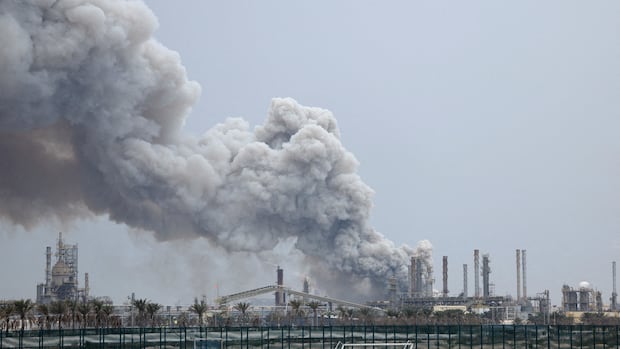
According to QatarEnergy’s CEO Saad al-Kaabi, the Iranian strikes have incapacitated 17% of Qatar’s LNG export capacity, jeopardizing supplies to Europe and Asia.
He estimated the loss in annual revenue at around $20 billion USD.
Al-Kaabi noted that two of Qatar’s 14 LNG trains and one of its two gas-to-liquids (GTL) facilities sustained damage during the unprecedented attacks, and he indicated that repairs would prevent 12.8 million tonnes of LNG from reaching the market over the next three to five years.
SAMREF: Saudi Arabia
On Thursday, a drone strike targeted the SAMREF refinery, which is jointly owned by two of the largest energy corporations, Aramco and Exxon. The Saudi defense ministry confirmed the attack and stated that damage assessment is ongoing.
In a separate incident, Saudi air defenses intercepted and destroyed a ballistic missile aimed at the Red Sea port city of Yanbu, where SAMREF is located, according to the defense ministry.
SAMREF operates as the sole crude export facility in the country and stands as one of the leading refineries in the Middle East, processing over 400,000 barrels per day of Arabian Light crude oil, as noted on its website.
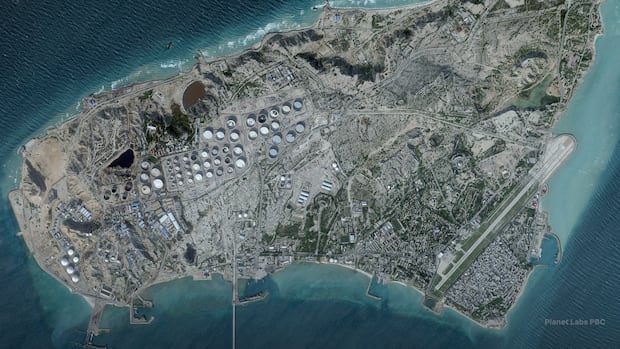
A tiny island in the Persian Gulf has become a pivotal asset in the U.S-Israeli war on Iran. For The National, CBC’s Ashley Fraser breaks down the strategic importance of Iran’s Kharg Island and why the U.S. military’s next move there is so high risk.
To circumvent the Strait of Hormuz, Saudi Arabia has started redirecting significant amounts of oil westward toward the Red Sea. The country, which is the leading oil exporter globally, has reduced its output by approximately two million barrels per day to around eight million after cutting production at two offshore fields.
In response to the attacks on Thursday, Qatar, Saudi Arabia, and the United Arab Emirates (UAE) issued a joint condemnation of Iran’s actions.
Additional targeted locations
Arab League Secretary-General Ahmed Aboul Gheit described the strikes on energy facilities as a “dangerous escalation.”
Meanwhile, operations at the Habshan gas facility in Abu Dhabi’s western region were halted following two incidents of falling debris from the successful interception of a missile, as reported by the Abu Dhabi Media Office. Additionally, the Bab oilfield, located south of Abu Dhabi, was also under threat.
-
Iran hits Qatar energy hub after its Pars oil field struck
-
Gulf states intercept new missiles, drones as Iran threatens to widen war
Drones also struck two refineries in Kuwait—Mina al-Ahmadi and Mina Abdullah—on Thursday, igniting fires at both locations, as reported by the state news agency. However, the extent of the damage remains unreported.
Kuwait had previously reduced its oil production.
In Israel, an Iranian missile targeted oil refineries in the northern port city of Haifa but reportedly did not inflict “significant damage,” according to Israel’s Minister of Energy and Infrastructure, Eli Cohen.
Cohen mentioned that power was temporarily disrupted on Thursday, but electricity has since been restored to the majority of affected areas.

