
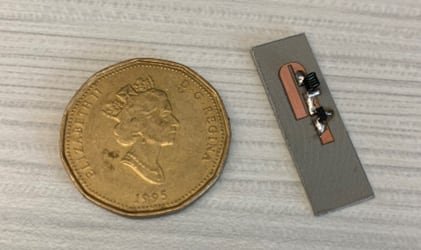
Researchers from the University of Alberta and Canada’s Department of National Defence have created a small sensor that operates without a battery. This sensor can monitor vital signs and identify frostbite in soldiers in harsh cold conditions. However, its potential applications extend beyond military settings.
Leading the project is Ashwin Iyer, a professor at the University of Alberta’s engineering faculty, collaborating with the Department of National Defence’s Innovation for Defence Excellence and Security program over several years.
The project aims to adapt commercial telecommunications technology for military purposes, leveraging the university’s cutting-edge research in SWaP-C systems—technology that emphasizes low size, weight, power, and cost.
Speaking on CBC’s The Trailbreaker, Iyer discussed the development of next-generation sensors for extreme cold environments.

Ashwin Iyer, a professor at the University of Alberta, is involved in developing battery-free health monitoring sensors for extreme environments. He shared insights with Shannon Scott.
This interview has been edited for length and clarity.
What was the initial problem you aimed to solve with this project?
The envisioned scenario was soldiers, Canadian or allied, stationed in extreme conditions like the High Arctic. Commanders needed a means to track their troops’ health remotely to detect potential issues such as frostbite, thus providing timely assistance. The concept involved a network of wearable biometric sensors on soldiers to monitor heart rate, respiration, core body temperature, and extremity temperature.

Why do traditional battery-operated devices fail in extremely cold temperatures, and how do your sensors address this issue?
Conventional battery-powered devices struggle in freezing conditions due to the limitations of lithium-ion batteries. To combat this, the team opted to eliminate batteries entirely by designing sensors that can generate power from their surroundings.
Explain the energy maintenance mechanism of these sensors.
Energy generation methods include motion-based harvesting, such as from walking. The sensors utilize radio frequency identification technology for power, commonly encountered in daily life. Energy absorbed from radio waves powers the sensors for data collection and transmission.
What led to the development of this technology and how did you overcome challenges?
The sensors needed to be compact, wireless, and non-intrusive. Shrinking the antennas, crucial for wireless functionality, required delving into decades of antenna research to achieve miniaturization without sacrificing performance.
How would the sensors detect frostbite in real-time for individuals in the field wearing gloves?</

