
In the coming weeks, if the skies are clear, you’ll have the chance to observe the International Space Station (ISS) as it traverses the night sky.
If you spot it, consider giving a wave to Canadian Space Agency astronaut Joshua Kutryk, who is zooming by at a speed of 7.66 kilometers per second.
Kutryk is part of a crew of seven members living and working aboard the orbiting lab during Expedition 75.
Since his arrival at the ISS on October 1, Kutryk has been engaged in various scientific experiments and duties, including a recent study on cardiac health.
Unsurprisingly, he has also been taking in the stunning views.
The ISS is frequently visible across Canada as it orbits our planet, and in the upcoming weeks, it will be more noticeable in the evening sky, unlike the early morning appearances it has made recently.
Locating the ISS in the Night Sky
In simple terms, it will appear as a very bright white dot — standing out against the multitude of dimmer stars and satellites — moving steadily across the sky. Unlike airplanes, it won’t have any flashing lights and will maintain a consistent direction.
-
Joshua Kutryk says he’s ‘having a blast’ on the International Space Station
-
Canadian astronaut Joshua Kutryk conducts his 1st spacewalk
Next, you’ll need to find out when the ISS will be passing by your location. There are several methods to do this.
One option is heavens-above.com, an independent platform that monitors numerous satellites and spacecraft. By entering your location, you can track the ISS along with a list of other visible objects. The site will then generate a schedule of times, similar to the one shown below.
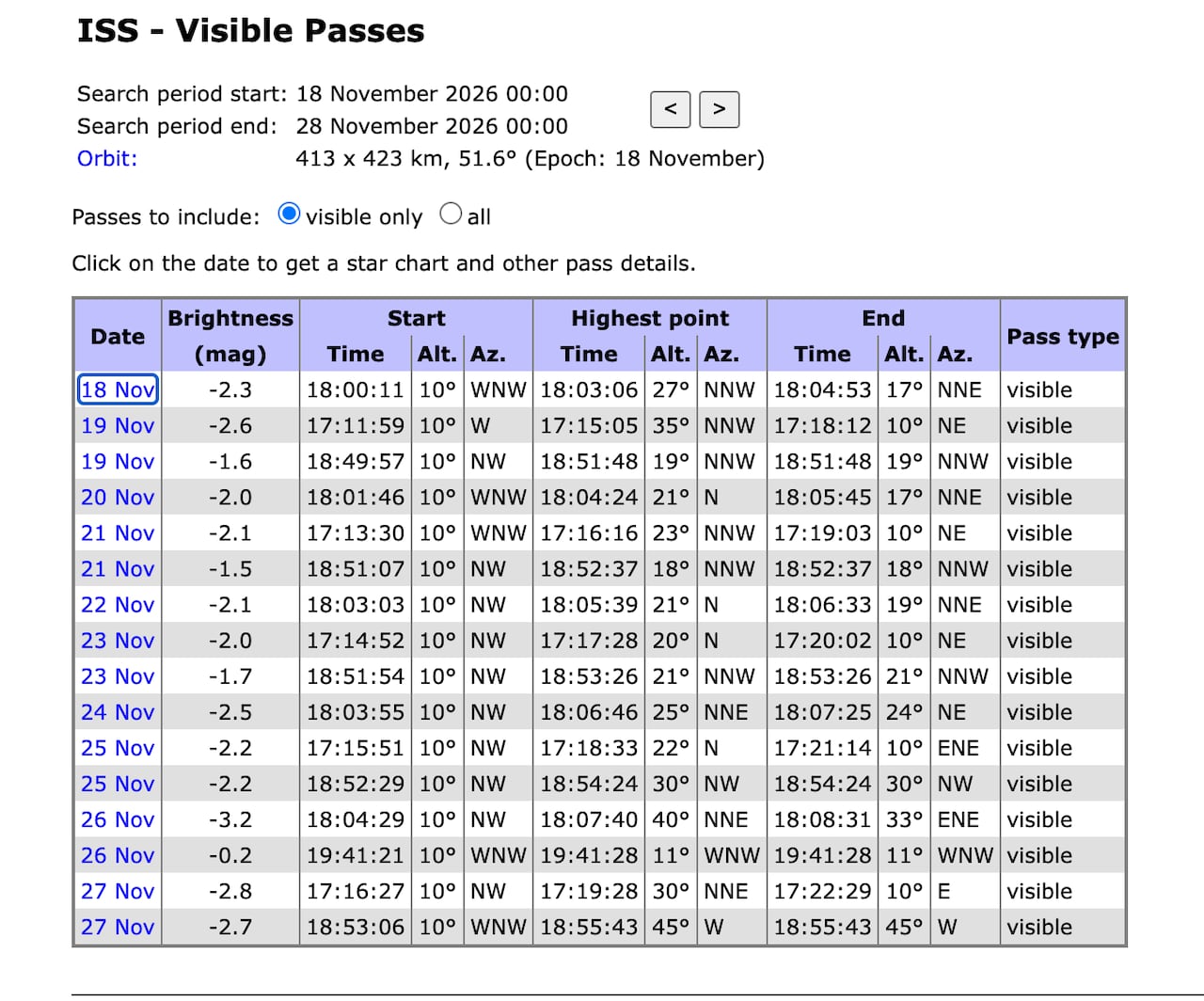
This chart indicates when the ISS will be visible over Toronto during the next weeks. (Heavens-above.com)
Regarding brightness, remember that a lower numerical value indicates greater brightness (it may seem counterintuitive, but that’s how astronomy works).
By clicking on a specific date, a sky map will display a line crossing various constellations, illustrating the ISS’s trajectory.
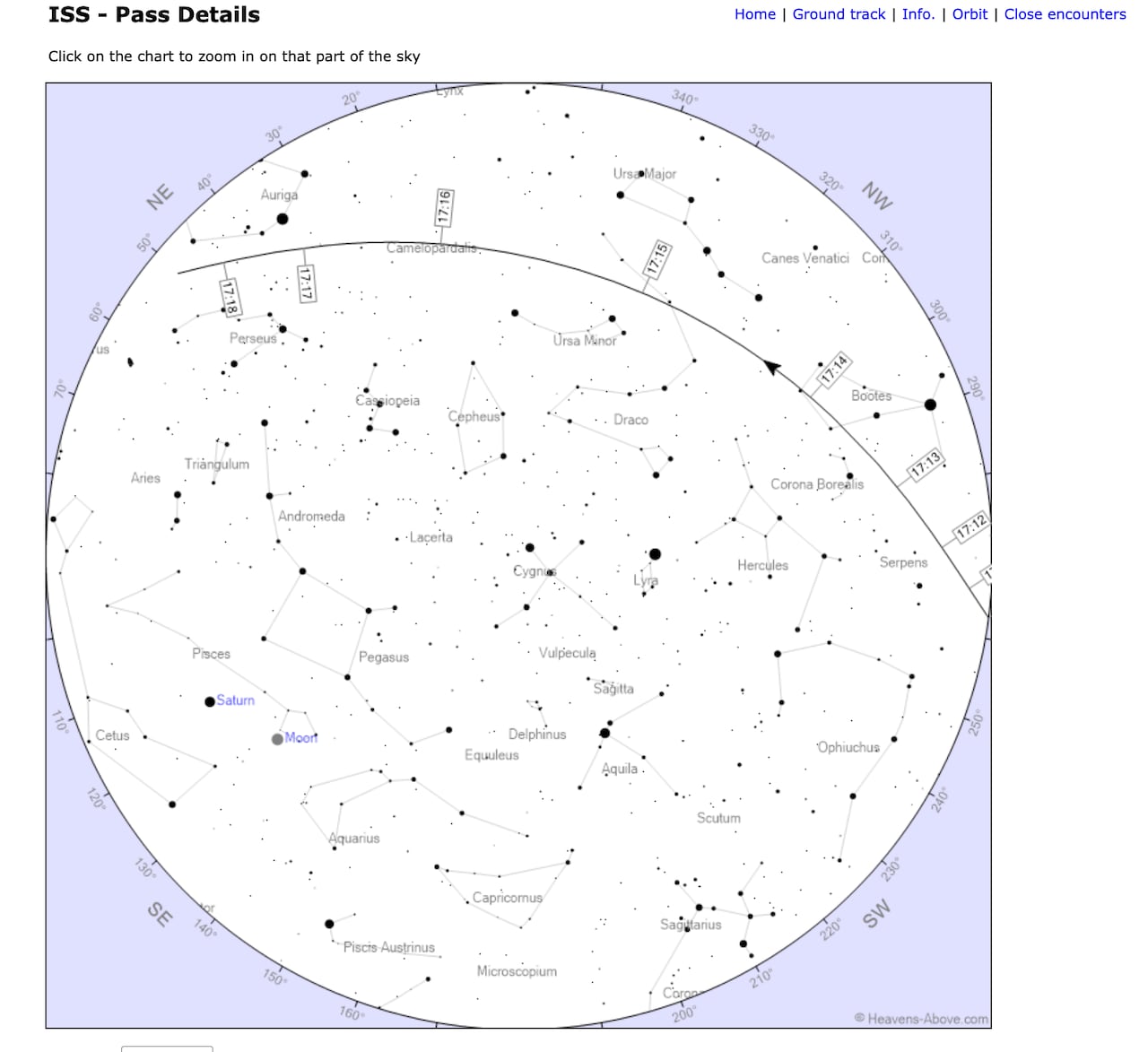
This sky map depicts the constellations and the route the ISS will take during this specific pass. (Heavens-above.com)
If the map shows only a short line near the horizon, you may want to skip that date, as spotting the ISS could be more challenging.
Conversely, if you see a longer line, it’s worth a try, provided you have a clear view.
The constellation map will also provide local timings for when the ISS will be visible, which is very helpful.
Another excellent tool is NASA’s Spot the Station app.
Upon opening the app, it should automatically pinpoint your location. The home screen will display a countdown to the next ISS pass. By clicking the “Sightings” button, you can see a list of upcoming passes.
Additionally, it features an AR View (augmented reality) function, allowing you to see sky details when you hold your phone up — including a line that shows the ISS’s path.
If you manage to spot the ISS as it crosses the sky, just imagine: perhaps Joshua Kutryk is glancing back at you.

