
Liberal MP Michael Ma is under fire for a series of pointed inquiries during a parliamentary committee that seemed to diminish the severity of forced labour in China.
In a statement released late Thursday, Ma expressed regret to the witness but contended that opposition MPs and media misinterpreted the region of China he referenced.
“I denounce forced labour in all its manifestations,” the statement read. “Canada possesses some of the most stringent laws against forced labour imports globally, and I take pride in supporting the government’s initiatives aimed at eliminating forced labour from supply chains and enforcing Canada’s import restrictions.”
The backlash arose from Ma’s questioning of expert witness Margaret McCuaig-Johnston during the industry committee’s discussions on the federal government’s electric vehicle policies, which recently revealed plans to allow certain Chinese electric vehicles to enter Canada at reduced tariff rates.
This agreement has drawn criticism, especially from the Conservative opposition.
McCuaig-Johnston, a senior fellow at the University of Ottawa, previously served as a federal assistant deputy minister and holds a master’s degree in international relations with a focus on China.
During the committee session, Ma posed a rapid succession of yes or no questions that seemed intended to challenge her expertise and the claims of human rights violations against China.
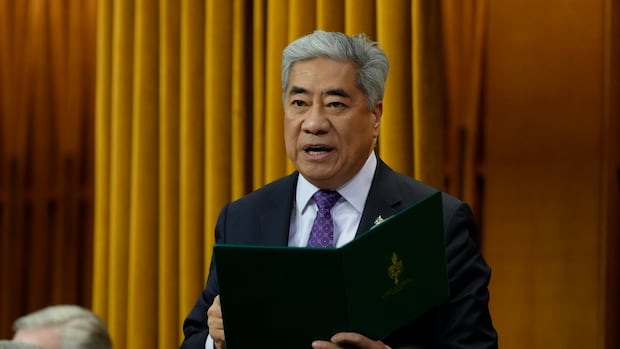
During a parliamentary committee on Thursday, Liberal MP Michael Ma inquired of Margaret McCuaig-Johnston from the China Strategic Risks Institute if she had personally seen forced labour in China. ‘I collaborate closely with Human Rights Watch where researchers have observed it,’ McCuaig-Johnston replied. Correction: The initial description of this video stated that Michael Ma inquired about forced labour in Xinjiang, China. In reality, he was referring to Shenzhen.
He questioned whether she possessed a degree in cybersecurity — which she does not — whether her affiliated institute investigates non-existent risks in China, and ultimately, whether she had personally observed forced labour in Shenzhen.
“Have you seen this firsthand?” he pressed. “Have you ever visited?”
“I have traveled to China numerous times since 1979,” McCuaig-Johnston replied.
“Just a brief answer. Have you witnessed forced labour in Shenzhen? Yes or no,” Ma insisted. “Did you learn of it through hearsay?”
She countered by stating that she collaborates closely with Human Rights Watch, where researchers have indeed witnessed it.
Several attendees at the committee meeting, including opposition MPs and journalists, mistakenly believed Ma was asking if she had seen forced labour in Xinjiang, a region of China notorious for human rights violations, including forced labour.
Ma later corrected the record, clarifying that he was referring to Shenzhen, a key automotive manufacturing center in China.
-
China sanctions Canadian institutions active on Uyghurs, Tibet
-
Canada, U.S. offered Uyghurs in Thailand asylum before their deportation to China: sources
-
Chinese government responsible for genocide in Xinjiang, says independent report
After the session, McCuaig-Johnston posted on X that she had provided Ma with a copy of the Human Rights Watch report titled “Asleep at the Wheel,” which outlines the use of aluminum sourced from Xinjiang in Chinese electric vehicles.
In 2021, the Parliament of Canada characterized China’s treatment of Uyghurs in Xinjiang, including forced labour, as “genocide” in a motion that received backing from all opposition parties and several members of the Liberal Party.
Similar motions have been passed by the governments of the U.K., United States, and Netherlands.
Canada has enacted sanctions in response to China’s human rights violations.
As recently as this year, United Nations experts have voiced “deep concern regarding ongoing allegations of forced labour” impacting minority groups, including Uyghurs, in Xinjiang.
-
MARKETPLACE
Canada’s grocery chains stocked with tomato products connected to Chinese forced labour
-
U.S. politicians press Canada in writing on anti-forced-labour failure
-
What is Canada doing to crack down on goods produced using forced labour?
As he exited the House of Commons, Ma was approached by CBC News and asked if he believed that forced labour exists in China.
“I think forced labour exists worldwide,” he replied, declining to specify whether it occurs in China.
Ma did not offer additional comments. The Markham-Unionville MP attracted attention late last year when he left the Conservative caucus to join the ruling Liberals.
His office issued a statement claiming that he employed a “common CPC strategy” of posing brief yes or no questions to a witness “to steer the discussion.”
According to an email from his office to CBC News, Ma “utilized a rapid sequence of [yes or no] questions to divert from the anti-China electric vehicle witness and subsequently yield the floor to the pro-China electric vehicle witness. That was the intended strategy.”
In a post-hearing interview with CBC News, McCuaig-Johnston indicated that she recognized at the time that Ma was employing a tactic.
“It was frankly a foolish question on his part,” she remarked. “I believe he was attempting to undermine what I might express regarding forced labour, which is unfortunate, as the government has implemented robust legislation addressing forced labour.”

