
On Sunday, Iran issued its own threats following U.S. President Donald Trump’s warning that the U.S. would “obliterate” Iran’s power facilities if the nation did not fully open the Strait of Hormuz within 48 hours.
Iranian missiles targeted two cities near Israel’s primary nuclear research facility, resulting in numerous injuries and extensive damage to residential buildings.
These events indicated a troubling escalation in the ongoing Middle East conflict, which has now persisted for four weeks.
Sirens rang out across Israel as Iran unleashed fresh missile strikes on Sunday. In southern Israel, communities in Dimona and Arad experienced significant destruction. Meanwhile, in northern Israel, a man lost his life due to an attack by the Lebanese militant group Hezbollah.
Israeli Prime Minister Benjamin Netanyahu visited Arad and described it as a “miracle” that there were no fatalities from the explosion, which caused major damage to multiple structures. He emphasized that if residents had promptly sought shelter, injuries could have been avoided, urging everyone to respond to the sirens.
Iran reacts to Trump’s ultimatum
On Saturday, Trump stated he would allow Iran 48 hours to open the crucial Strait of Hormuz or face renewed military action. He warned that the U.S. would target “various POWER PLANTS, STARTING WITH THE BIGGEST ONE FIRST!”
He likely referred to Iran’s largest power plant, Bushehr, which was attacked the previous week, or the Damavand natural gas facility located near Tehran, the capital of Iran.

Donald Trump seemed thrilled when Ayatollah Ali Khamenei was killed on day one of the war, but diplomats and military experts say the U.S. underestimated the Iranian resolve. For The National, CBC’s Terence McKenna explores the American miscalculations and how they could shape war’s endgame.
In response, Iran cautioned early Sunday that any attack on its energy facilities would lead to assaults on U.S. and Israeli energy and infrastructure assets, particularly targeting information technology and desalination plants in the area, as stated by an Iranian military spokesperson in a report by state media and semi-official outlets.
The International Committee of the Red Cross (ICRC) asserts that under the Geneva Conventions of 1949, power plants are classified as civilian infrastructure and should not be attacked, as this could “release dangerous forces and cause severe losses among the civilian population.”
The ICRC notes that an exception to this rule could apply only if the facilities provide “regular, significant and direct support of military operations and if such attack is the only feasible way to terminate such support.”
The Strait of Hormuz serves as a vital connection between the Persian Gulf and the Indian Ocean, representing a key route for global oil transportation. Attacks on commercial vessels and warnings of additional strikes have halted nearly all tankers from transporting oil, gas, and other commodities through this critical passage, resulting in production reductions from some of the world’s leading oil exporters as their crude oil has no destination.
Seyed Ali Mousavi, Iran’s representative to the International Maritime Organization, indicated in statements reported by two Iranian news outlets that navigation through the strait is possible for “everyone except enemies,” suggesting that Tehran would decide which vessels are permitted to pass. Iran has already allowed ships to transit the waterway to destinations such as China and other locations in Asia.
Iran targets area near Israeli nuclear facility
Israel’s military reported that it was unable to intercept missiles that struck Dimona and Arad on Saturday, the largest cities in proximity to the Negev Desert nuclear facility. This marked the first occasion that Iranian missiles breached Israel’s air defense systems in that region.
“If the Israeli regime cannot intercept missiles in the heavily fortified Dimona area, it operationally signifies the onset of a new phase in the conflict,” commented Iran’s parliament Speaker, Mohammad Bagher Ghalibaf, on the social media platform X.
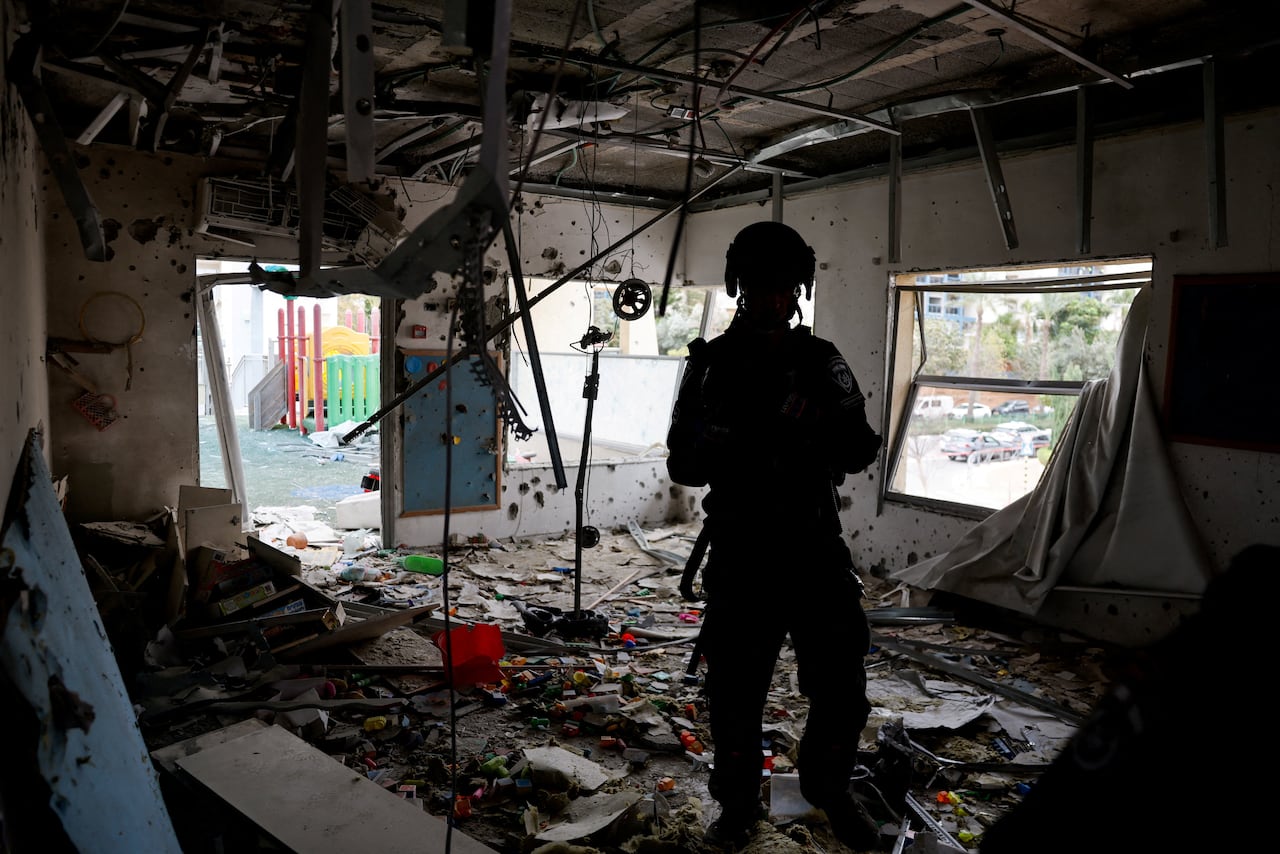
An Israeli soldier stands inside a kindergarten that was hit by Iranian attacks in Rishon LeZion, Israel, on Saturday. (Amir Cohen/Reuters)
Rescue teams reported that at least 64 individuals were hospitalized following the direct hits in Arad. Dimona is located approximately 20 kilometers west of the nuclear research center, while Arad is about 35 kilometers to the north.
Itamar Ben-Gvir, Israel’s national security minister, visited Arad on Sunday, declaring that the country is engaged in a “historic battle” against Iran and emphasized the need for the fight to “continue until victory.”
Although Israel is widely believed to possess nuclear weapons, it neither confirms nor denies this. The United Nations nuclear watchdog reported on X that it has not received any indications of damage to the Israeli facility or abnormal radiation levels.
Israel refutes involvement in nuclear enrichment facility attack
Earlier on Saturday, Iran’s primary nuclear enrichment site at Natanz was attacked. Israel has denied any involvement in this assault, and the official news agency of Iran’s judiciary, Mizan, reported that there was no leakage.
The Pentagon refrained from commenting on the incident at Natanz, which had also been targeted during the first week of the current conflict and in the 12-day war last June.
According to the UN watchdog, the International Atomic Energy Agency, most of Iran’s estimated 441 kilograms of enriched uranium is located elsewhere, beneath the rubble at its Isfahan facility.
The U.S. and Israel have provided varying justifications for the conflict, ranging from aspirations to incite an uprising against Iran’s leadership to dismantling its nuclear and missile programs and its backing of armed proxies. There have been no indications of an uprising, while internet restrictions hinder information flow from Iran.
The impact of the war extends well beyond the Middle East, causing increases in food and fuel prices.
According to reports from the state broadcaster on Saturday, the death toll in Iran has exceeded 1,500, as cited by the Health Ministry. In Israel, 15 individuals have died from Iranian missile attacks. Four more fatalities have occurred in the Israeli-occupied West Bank. Additionally, at least 13 U.S. military personnel have lost their lives, along with over a dozen civilians in Gulf nations.
Hezbollah claims responsibility for lethal strike in northern Israel
In another development, the Iranian-backed militant group Hezbollah announced its involvement in a strike on Sunday that resulted in a fatality in the northern Israeli town of Misgav Am, which the Israeli military described as “seemed to be” a rocket attack. Israeli medics discovered the deceased man in his vehicle and released footage showing two burning cars.
Hezbollah, an ally of Iran, commenced assaults on Israel shortly after the U.S.-Israeli offensive against Iran began on February 28, claiming it was in retaliation for the assassination of Iran’s Supreme Leader Ayatollah Ali Khamenei.
In retaliation, Israel launched airstrikes targeting Lebanon and Hezbollah, intensifying its military presence in southern Lebanon and increasing troop deployments near the border.
Lebanese officials report that Israeli strikes have resulted in over 1,000 casualties and displaced more than one million people.
Helicopter crash in Qatar
In Doha, six fatalities were confirmed from a Qatari helicopter crash that occurred in the nation’s territorial waters. One individual remained unaccounted for following Saturday’s incident, attributed to a “technical malfunction.”
According to Qatar’s Defense Ministry, the deceased included three members of the Qatari forces and three Turkish nationals, comprising a military officer and two civilians. The missing person is a Qatari airman, the ministry stated.

