
Researchers were both surprised and thrilled to find a previously unrecorded baby right whale swimming alongside its mother near the shores of Quebec.
The stealthy North Atlantic right whale calf, weighing in at 6,804 kilograms, had managed to escape the vigilant attention of scientists who monitor endangered species populations.
This was until it was captured in a photograph in September off Anticosti Island.
“To be completely honest, I was a bit skeptical at first,” said Amy Warren, a scientist at the New England Aquarium’s Anderson Cabot Center, during an interview with As It Happens host Nil Kӧksal.
However, Warren and her team meticulously verified the find by recognizing the mother and matching the calf’s unique markings with those of other documented whales.
The unexpected sighting raises the total number of calves from the latest birthing season to 24, marking the most successful year for the species since 2009 and the fourth-largest count in history, according to the aquarium.
“This year certainly brings a significant amount of hope and optimism,” Warren stated.

Warren notes that scientists dedicated to studying North Atlantic right whales often struggle to find reasons for optimism.
Currently, there are only 380 individuals remaining globally, as reported by the U.S. National Oceanic and Atmospheric Administration, with their numbers declining by 25 percent from 2010 to 2020. Approximately 70 of these are known to be of reproductive age.
This decline is partly attributed to rising ocean temperatures pushing these whales out of safe zones and into areas where they are highly at risk of colliding with large vessels and becoming entangled in fishing gear.
“It can be incredibly distressing to witness these whales enduring traumatic experiences. We document their scars and injuries and spend considerable time discussing and examining these issues,” Warren expressed.
“So, to see these calves and observe so many of them is… truly uplifting.”
Trend or anomaly?
There is a possibility that conditions are improving. Since 2020, the population of North Atlantic right whales has slightly increased, as per Fisheries and Oceans Canada, and the surge in calves this year has scientists feeling cautiously optimistic.
Nevertheless, Warren cautions that it is premature to conclude whether this is indicative of a positive trend or merely a one-time occurrence.
“It’s possible they have discovered better feeding grounds. That seems plausible,” she remarked.
“We long to believe that the protective measures being implemented by researchers and management are effective. However, it’s difficult to assert that with certainty.”
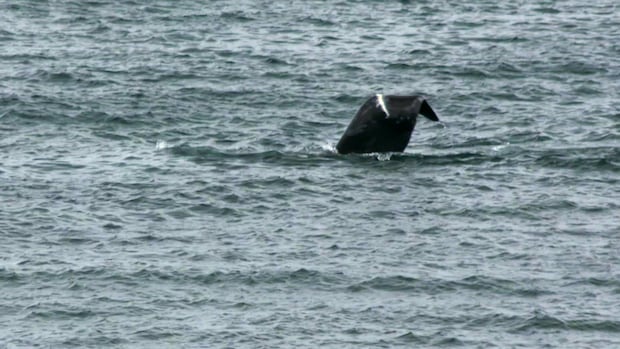
Videographers Heather MacAulay and Chris Murphy captured a remarkable sighting on September 1 when they encountered a North Atlantic right whale off the coast of Blackhead Cove, N.L. The species is critically endangered, but there are encouraging signs suggesting a potential stabilization in their population.
The new calf is the offspring of a female known as Silt, who researchers estimate to be at least 38 years old. This marks her sixth offspring.
“She is a very experienced mother,” Warren noted. “Her last calf was born in 2022, so this timing aligns well for her to give birth this year.”
While right whales can technically have calves every three years, Warren explains that in practice, they typically wait between five and ten years.
However, she observes that this gap seems to be narrowing.
“This year, we noticed that the average interval for females has been closer to five years, whereas ten years ago, it was about ten years between calves.”
How did this calf stay hidden?
These elusive marine mammals typically give birth in the winter off the southeastern U.S. before migrating northward to New England and Canada for feeding, and scientists closely monitor their populations, extensively photographing and cataloging them based on their unique head patterns.
Warren explains that calves are difficult to overlook as they are still mastering swimming and cannot hold their breath for extended periods.
“Mothers and their calves often stay close to the surface, making them easier to spot,” Warren added.
“Thus, the fact that this mother-calf pair managed to travel from that area all the way to Canada and nearly back without being detected by any surveys along the route is quite remarkable and rare.”
-
North Atlantic right whales at greater risk of collision with boats at night: study
-
Internal DFO memo warns Trump-backed bill threatens right whale survival
The pair was observed by researchers from the Mingan Island Cetacean Study, a non-profit organization dedicated to marine research in the coastal Côte-Nord region.
“This highlights just how vast the ocean is and how these animals can easily get lost within it,” remarked Richard Sears, founder and director of Mingan Island Cetacean Study.
Warren, on her part, expresses her hope that this event signifies a more promising future for North Atlantic right whales.
“That is indeed the hope,” she said. “However, we will see how things unfold in the coming years.”

